


The Open Group OGBA-101 Dumps Updated Oct 16, 2023 WIith 43 Questions
View All OGBA-101 Actual Free Exam Questions Oct 16, 2023 Updated
NEW QUESTION # 18
Which statement best describes iteration and the ADM?
- A. The ADM is iterative between phases B to D, and between Phases E and F.
- B. The ADM is iterative, over the whole process, between phases, and within phases.
- C. The level of detail is defined once and applies to all iterations.
- D. The ADM is sequential. Iteration is applied within phases.
Answer: B
Explanation:
The statement that best describes iteration and the ADM is that the ADM is iterative, over the whole process, between phases, and within phases4. Iteration is a key concept in managing the complexity of developing an Enterprise Architecture and managing its lifecycle4. The ADM supports several forms of iteration as follows:
Iteration over the whole process: Projects will iterate through the entire ADM cycle, commencing with Phase A (Architecture Vision) and ending with Phase H (Architecture Change Management)4. Each cycle of the ADM will be bound by a Request for Architecture Work that defines the scope and objectives of the project4. The architecture output will populate or update the Architecture Landscape that describes the current and target states of the enterprise4.
Iteration between phases: Projects may cycle between ADM phases in planned cycles covering multiple phases4. Typically, this is used to converge on a detailed Target Architecture when higher-level architecture does not exist to provide context and constraint4. For example, a project may iterate between Phase B (Business Architecture), Phase C (Information Systems Architectures), and Phase D (Technology Architecture) until a satisfactory solution is achieved4.
Iteration within phases: Projects may return to previous activities within an ADM phase in order to circle back and update work products with new information4. Typically, this is used to manage the inter-relationship between different aspects of an architecture domain or viewpoint4. For example, a project may revisit Business Architecture models after developing Information Systems Architecture models to ensure alignment and consistency4.
NEW QUESTION # 19
Consider the diagram.
What are the items labelled A, B and C?
- A. A-Architecture Vision, B-Business Architecture. C-lnformation Systems Architecture
- B. A-Enterprise Architecture, B-Architecture Building Blocks, C-Solutions Building Blocks
- C. A-Enterprise Strategic Architecture, B-Segment Architecture, C-Solutions Architecture
- D. A-Enterprise Continuum, B-Architecture Continuum. C-Solutions Continuum
Answer: D
Explanation:
The diagram shows the Enterprise Continuum, which is a view of the Architecture Repository that provides methods for classifying architecture and solution artifacts as they evolve from generic Foundation Architectures to Organization-Specific Architectures4. The Enterprise Continuum comprises two complementary concepts: the Architecture Continuum and the Solutions Continuum. The Architecture Continuum shows the relationships among foundational frameworks, common system architectures, industry architectures, and enterprise architectures4. The Solutions Continuum shows the relationships among foundational solutions, common system solutions, industry solutions, and enterprise solutions4.
NEW QUESTION # 20
Consider the following:
In Phase A a business capability map and a core set of value streams were created while developing the Architecture Vision.
Why would such Architecture Descriptions need to be updated in Phase B?
- A. Phase B requires that all Architecture Descriptions be updated.
- B. Phase B is an ADM Architecture Development phase.
- C. A new value stream was assessed as in the project scope.
- D. The development of Business Architecture Descriptions is always iterative.
Answer: D
Explanation:
The development of Business Architecture Descriptions is always iterative because it involves constant refinement and validation of the architecture models and views based on stakeholder feedback and changing requirements. Therefore, any Architecture Description that was created in Phase A may need to be updated in Phase B as new information or insights emerge. Phase B does not require that all Architecture Descriptions be updated, only those that are relevant and necessary for the Business Architecture. Phase B is an ADM Architecture Development phase, but that does not explain why Architecture Descriptions need to be updated. A new value stream may or may not require updating existing Architecture Descriptions depending on its scope and impact.
NEW QUESTION # 21
Which of the following best describes a business capability?
- A. It is an articulation of the relationships between business entities that make up the enterprise.
- B. It delineates what a business does without an explanation of how, why, or where the capability is used.
- C. It is a detailed description of the architectural approach to realize a particular solution.
- D. It is a qualitative statement of intent that should be met by the enterprise architecture capability developing the business architecture.
Answer: B
Explanation:
According to the TOGAF Series Guide to Business Capabilities (Version 2), a business capability is defined as "a particular ability or capacity that a business may possess or exchange to achieve a specific purpose or outcome" 4. A business capability delineates what a business does without an explanation of how, why, or where the capability is used4. A business capability can be expressed as a verb phrase that indicates what function or service the capability provides4. For example, some possible business capabilities are "Manage Customer Relationships", "Deliver Products", or "Perform Financial Analysis".
NEW QUESTION # 22
Refer to Exhibit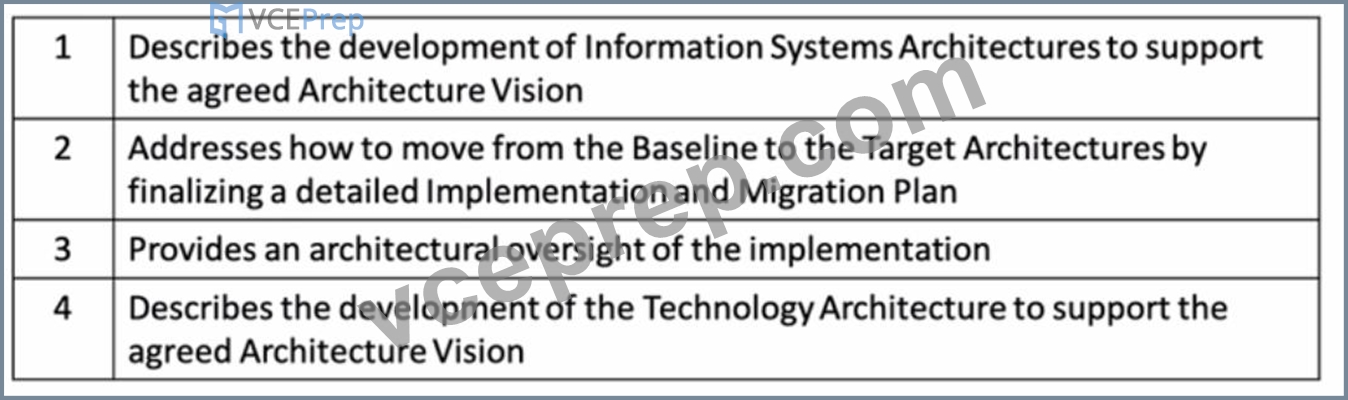
- A. 1 Phase C - 2 Phase E - 1 Phase H - 4 Phase C
- B. 1 Phase C - 2 Phase F - 3 Phase H - 4 Phase B
- C. 1 Phase D - 2 Phase B - 3 Phase G - 4 Phase A
- D. 1 Phase C - 2 Phase F - 3 Phase G- 4 Phase D
Answer: C
Explanation:
The diagram of the ADM phases matches the following purpose descriptions:
1 Phase D: This phase is responsible for developing the Technology Architecture that defines the logical software and hardware capabilities that are required to support the deployment of business, data, and application services1. This includes defining the technology platforms, principles, standards, and policies that will enable and govern the implementation of the Target Architecture1.
2 Phase B: This phase is responsible for developing the Business Architecture that describes how the enterprise needs to operate to achieve the business goals, and respond to the strategic drivers set out in the Architecture Vision1. This includes defining the business strategy, governance, organization, and key business processes1.
3 Phase G: This phase is responsible for implementing governance and management frameworks over architecture contracting, monitoring, and compliance1. This includes establishing an implementation governance model, defining architecture contracts and compliance reviews, and monitoring and supporting the implementation projects1.
4 Phase A: This phase is responsible for developing the Architecture Vision that describes the scope and approach for the overall architecture project1. This includes defining the problem statement, objective, scope, stakeholders, business requirements, and high-level architecture vision1.
NEW QUESTION # 23
Which of the following is a derived relationship in an organization map?
- A. Scope of enterprise
- B. Capability
- C. Value flow
- D. Location
Answer: C
Explanation:
According to the TOGAF Series Guide: Organization Mapping, one of the derived relationships in an organization map is value flow1. A value flow is a relationship that shows how value is exchanged between business units or other entities in an organization map1. A value flow can be expressed as a verb phrase that indicates what type of value is transferred or shared between entities1. For example, in an organization map for an online retailer, a possible value flow could be "Delivers products" between the Warehouse business unit and the Customer entity.
NEW QUESTION # 24
Which of the following is a purpose of mapping capabilities to value stream stages?
- A. To identify and eliminate business capabilities that do not contribute to the business.
- B. To describe the business in terms of services provided and consumed.
- C. To provide a self-contained business description that is independent of the organizational structure.
- D. To classify, group, and align capabilities into categories for a deeper understanding.
Answer: D
Explanation:
One of the purposes of mapping capabilities to value stream stages is to classify, group, and align capabilities into categories for a deeper understanding of how they support value creation and delivery2. By mapping capabilities to value stream stages, the architect can identify which capabilities are required for each stage of the value stream, how they relate to each other, and how they contribute to the overall value proposition. This can help to assess the maturity, effectiveness, performance, and value or cost contribution of each capability.
NEW QUESTION # 25
Which of the following supports the need to govern Enterprise Architecture?
- A. The Architecture Project mandates the governance of the target architecture.
- B. The stakeholder preferences may go beyond the architecture project scope and needs control.
- C. Best practice governance enables the organization to control value realization.
- D. The TOGAF standard cannot be used without executive governance.
Answer: C
Explanation:
One of the reasons that supports the need to govern Enterprise Architecture is that best practice governance enables the organization to control value realization6. Value realization is the process of ensuring that the expected benefits from implementing an Enterprise Architecture are achieved and sustained over time6. Best practice governance provides a framework and mechanisms for monitoring and evaluating the performance and outcomes of Enterprise Architecture initiatives, as well as ensuring alignment with strategic objectives and stakeholder expectations.
NEW QUESTION # 26
Which of the following describes how business models are used within the TOGAF standard?
- A. To document the factors impacting the business migration plan.
- B. To help formulate architecture and business principles.
- C. To identify, classify, and mitigate risks to the business.
- D. To tailor the enterprise architecture for the business.
Answer: B
Explanation:
Business models are used within the TOGAF standard to help formulate architecture and business principles4. A business model describes how an organization creates, delivers, and captures value for its stakeholders4. A business model can help to define the strategic direction, goals, and objectives of the organization, which can then inform the development of architecture and business principles that guide the design and evolution of the enterprise architecture.
NEW QUESTION # 27
Which of the following best describes a TOGAF business scenario?
- A. A use-case providing detailed descriptions.
- B. A method to develop a business model.
- C. A technique to elaborate an architecture effort.
- D. A business case.
Answer: C
Explanation:
A TOGAF business scenario is a technique that can be used to fully understand the requirements of information technology and align it with business needs1. It is not a business case, which is a document that provides justification for a proposed project or initiative6. It is not a method to develop a business model, which is a description of how an organization creates, delivers, and captures value for its stakeholders7. It is not a use-case, which is a description of how a system interacts with external actors to achieve a specific goal.
NEW QUESTION # 28
Consider the following example using the Business Model Canvas: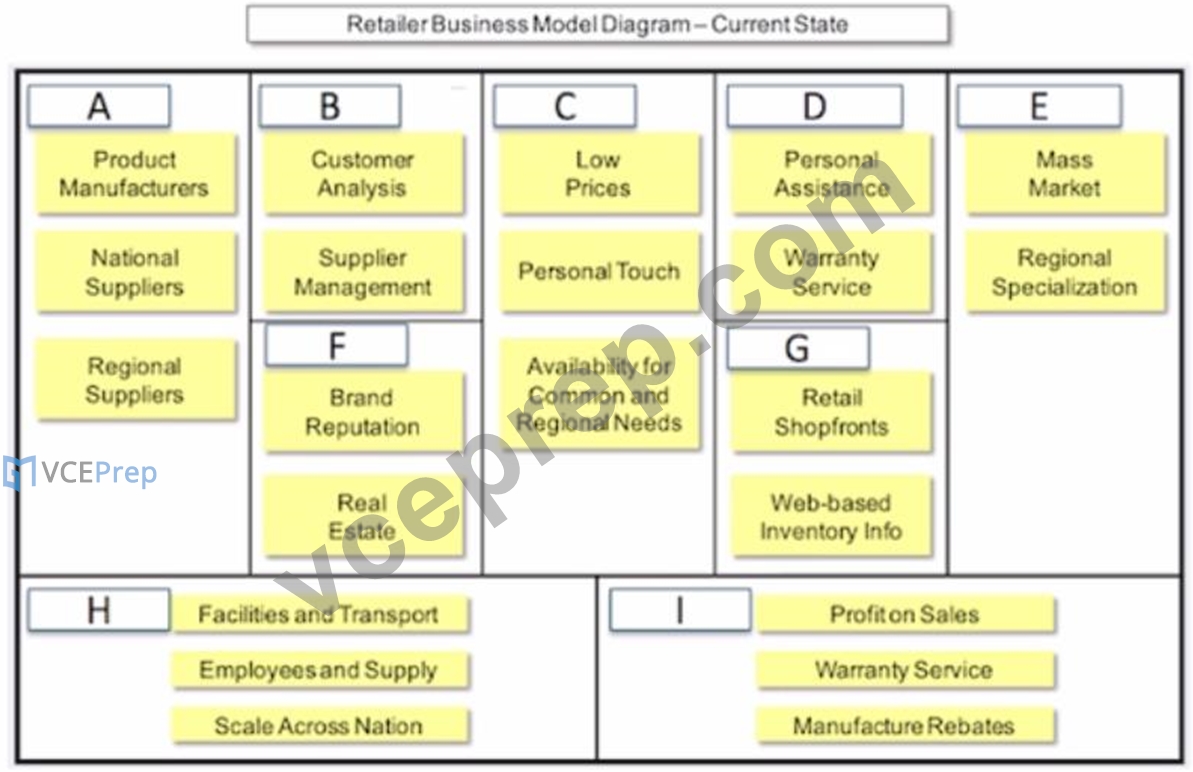
What are the segments labeled A, D and I?
- A. Key Resources. Revenue Streams. Cost Structure
- B. Key Partners, Customer Relationships, Revenue Streams.
- C. Customer Relationships, Value Propositions, Market Segments.
- D. Customer Segments, Value Add Services, Profit Channels.
Answer: B
Explanation:
The segments labeled A, D and I in the Business Model Canvas are Key Partners, Customer Relationships, and Revenue Streams respectively1. The Business Model Canvas is a tool that can be used to describe how an organization creates, delivers, and captures value for its stakeholders1. The Business Model Canvas consists of nine segments that cover four main areas: customers (segments B,C,D), offer (segment E), infrastructure (segments A,F,G), and financial viability (segments H,I)1. The segments are defined as follows:
Key Partners (segment A): The network of suppliers and partners that make the business model work1. Key partners can provide resources, activities, or support that enable the organization to offer its value proposition1.
Customer Relationships (segment D): The type of relationship that the organization establishes with its customer segments1. Customer relationships can be driven by customer acquisition, retention, or loyalty objectives1. Customer relationships can also influence the customer experience and satisfaction1.
Revenue Streams (segment I): The sources of income that the organization generates from each customer segment1. Revenue streams can be derived from different pricing mechanisms, such as asset sale, subscription, fee, commission, or advertising1. Revenue streams can also reflect the value that customers are willing to pay for the organization's offer1.
NEW QUESTION # 29
Consider the following modeling example, relating business capabilities to organization units so as to highlight duplication and redundancy:
(Note in this example the cells colored green, yellow, and red, are also marked G. Y, and R, respectively) Which of the following best describes this technique?
- A. Gap Analysis
- B. Capability Mapping
- C. Relationship Mapping
- D. Perspective Analysis
Answer: C
Explanation:
The technique shown in the example is called relationship mapping. It is a technique that can be used to show how a business architecture addresses stakeholder concerns across different parts of an organization2. It can highlight gaps or overlaps in the coverage of stakeholder concerns by a business architecture. In this case, the technique is used to relate business capabilities to organization units so as to highlight duplication and redundancy.
NEW QUESTION # 30
Which of the following is a benefit of information mapping?
- A. It provides a framework for effective business requirements analysis.
- B. It provides a basis to support decision-making throughout the business.
- C. It highlights information requirements not addressed by a business architecture.
- D. It enables improved business process integration.
Answer: B
Explanation:
One of the benefits of information mapping is that it provides a basis to support decision-making throughout the business1. Information mapping is a technique that can be used to document and visualize the information concepts and their relationships that are relevant for the business1. Information mapping can help to identify the information needs, sources, flows, quality, and value of the business, as well as the gaps, issues, and opportunities for improvement1. By providing a clear and consistent view of the information landscape, information mapping can enable better informed and more effective decisions at all levels of the business.
NEW QUESTION # 31
Which of the following is a difference between an organization map and an organization chart?
- A. An organization map reduces the time, cost, and risk of business operations.
- B. An organization map highlights where in the organization that stakeholder concerns are not being addressed by a business architecture.
- C. An organization map is limited to formal relationships between business units.
- D. An organization map can be impacted by a business model change.
Answer: B
Explanation:
An organization map is a technique that can be used to show how a business architecture addresses stakeholder concerns across different parts of an organization3. It can highlight gaps or overlaps in the coverage of stakeholder concerns by a business architecture. An organization chart, on the other hand, is a diagram that shows the formal structure and hierarchy of an organization, such as reporting relationships and roles4. An organization chart does not necessarily show how stakeholder concerns are addressed by a business architecture.
NEW QUESTION # 32
Which of the following is guidance for creating value streams?
- A. Include operational levels of detail.
- B. Start with customer-based value streams.
- C. Create an initial set of value streams that map one-to-one to existing capabilities.
- D. Identify the top-level value streams from components of capabilities.
Answer: B
Explanation:
One of the guidance for creating value streams is to start with customer-based value streams2. Customer-based value streams are those that describe how an enterprise creates and delivers value for its external customers2. Starting with customer-based value streams can help to ensure that the value streams are aligned with the customer needs and expectations, as well as the enterprise's value proposition and strategic objectives2. Customer-based value streams can also provide a foundation for identifying and defining other types of value streams, such as internal or partner-based value streams.
NEW QUESTION # 33
Refer to the table below:
Which ADM Phase(s) does this describe?
- A. Preliminary Phase
- B. Phase B. C and D
- C. Phase E
- D. Phase B
Answer: B
Explanation:
The table describes the steps involved in Phase B (Business Architecture), Phase C (Information Systems Architectures), and Phase D (Technology Architecture) of the TOGAF ADM5. These phases are responsible for developing the target architectures for each domain and identifying the gaps between the baseline and target architectures. The table shows the outputs and outcomes of each phase, as well as the essential knowledge required for each phase.
NEW QUESTION # 34
Which approach to model, measure, and analyze business value is primarily concerned with identifying the participants involved in creating and delivering value?
- A. Value chains
- B. Value networks
- C. Lean value streams
- D. Value streams
Answer: B
Explanation:
Value networks are an approach to model, measure, and analyze business value that is primarily concerned with identifying the participants involved in creating and delivering value3. Value networks focus on the relationships and interactions among the participants, such as customers, suppliers, partners, employees, and other stakeholders3. Value networks can help to understand how value flows through the network and how it can be improved or optimized.
NEW QUESTION # 35
......
New OGBA-101 Exam Questions Real The Open Group Dumps: https://actualtests.vceprep.com/OGBA-101-latest-vce-prep.html