


Latest Microsoft AZ-104 Exam questions and answers
VCEPrep AZ-104 Exam Practice Test Questions (Updated 520 Questions)
How to Prepare For AZ-104:Microsoft Azure Administrator Exam
Preparation Guide for AZ-104:Microsoft Azure Administrator Exam
Introduction
The Microsoft az-104 certification exam is important to your career but can be difficult to prepare for. This blog post will help you learn about the 100 questions on the exam based on previous exams, take practice exams based on sample questions, and increase your chances of passing. The Microsoft az-104 certification is a test that measures how well-experienced professionals understand software design principles provided by Azure. This test is part of the Professional Developer license program that requires an official nugget from Microsoft in order to achieve this certification status.
How to Register For Exam AZ-104: Microsoft Azure Administrator?
NEW QUESTION 172
You have a deployment template named Template1 that is used to deploy 10 Azure web apps.
You need to identify what to deploy before you deploy Template1. The solution must minimize Azure costs.
What should you identify?
- A. one App Service plan
- B. one Azure Application Gateway
- C. one Azure Traffic Manager
- D. 10 App Service plans
- E. five Azure Application Gateways
Answer: A
Explanation:
Section: [none]
Explanation:
You create Azure web apps in an App Service plan.
Reference:
https://docs.microsoft.com/en-us/azure/app-service/overview-hosting-plans
NEW QUESTION 173
You create an Azure file sync group named Sync 1 and perform the following actions:
* Add share as the cloud endpoint for Sync1.
* Add data1 as a server endpoint for Sync1.
* Register Server1 and Server2 to Sync1.
For each of the following statements, select Yes if the statement is true Otherwise, select No.
NOTE Each correct selection is worth one point.
Answer:
Explanation:
Explanation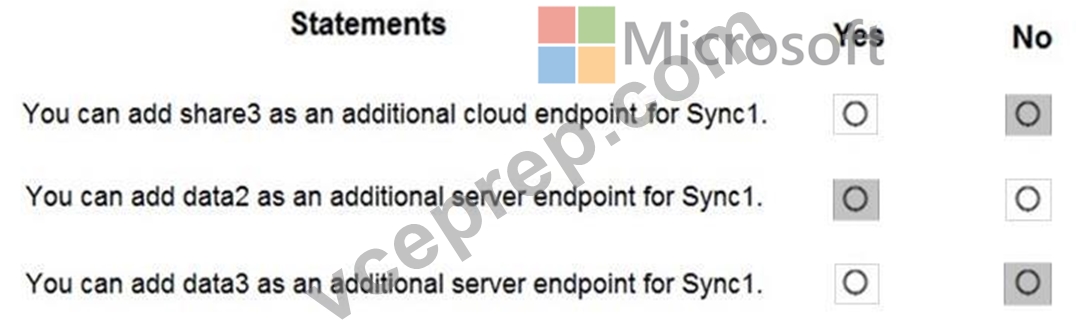
NEW QUESTION 174
You have an Azure subscription that contains the resources in the following table.
To which subnets can you apply NSG1?
- A. the subnets on VNet2. VNet2, and VNet3
- B. the subnets on VNet1 only
- C. the subnets on VNet3 only
- D. the subnets on VNet2 only
- E. the subnets on VNet2 and VNet3 only
Answer: C
Explanation:
All Azure resources are created in an Azure region and subscription. A resource can only be created in a virtual network that exists in the same region and subscription as the resource.
References:
https://docs.microsoft.com/en-us/azure/virtual-network/virtual-network-vnet-plan-design-arm
NEW QUESTION 175
You have a pay-as-you-go Azure subscription that contains the virtual machines shown in the following table.
You create the budget shown in the following exhibit.
The AG1 action group contains a user named [email protected] only.
Use the drop-down menus to select the answer choice that completes each statement based on the information presented in the graphic.
NOTE: Each correct selection is worth one point.
Answer:
Explanation:
Explanation
Box 1: VM1 is turned off, and VM2 continues to run
The budget alerts are for Resource Group RG1, which include VM1, but not VM2.
Box 2: one email notification will be sent each month.
Budget alerts for Resource Group RG1, which include VM1, but not VM2.VM1 consumes 20 Euro/day. The
50% ,500 Euro limit, will be reached in 25 days, and an email will be sent.
The 70% and 100% alert conditions will not be reached within a month, and they don't trigger email actions anyway.
Credit alerts: Credit alerts are generated automatically at 90% and at 100% of your Azure credit balance.
Whenever an alert is generated, it's reflected in cost alerts and in the email sent to the account owners. 90% and 100% will not be reached though.
References:
https://docs.microsoft.com/en-us/azure/cost-management-billing/costs/cost-mgt-alerts-monitor-usage-spending
NEW QUESTION 176
Your network contains an Active Directory domain named adatum.com and an Azure Active Directory (Azure AD) tenant named adatum.onmicrosoft.com.
Adatum.com contains the user accounts in the following table.
Adatum.onmicrosoft.com contains the user accounts in the following table.
You need to implement Azure AD Connect. The solution must follow the principle of least privilege.
Which user accounts should you use? To answer, select the appropriate options in the answer area.
NOTE: Each correct selection is worth one point.
Answer:
Explanation:
NEW QUESTION 177
Note: This question is part of a series of questions that present the same scenario. Each question in the series contains a unique solution that might meet the stated goals. Some question sets might have more than one correct solution, while others might not have a correct solution.
After you answer a question in this section, you will NOT be able to return to it. As a result, these questions will not appear in the review screen.
You have an Azure Active Directory (Azure AD) tenant named Adatum and an Azure Subscription named Subscription1. Adatum contains a group named Developers. Subscription1 contains a resource group named Dev.
You need to provide the Developers group with the ability to create Azure logic apps in the Dev resource group.
Solution: On Dev, you assign the Contributor role to the Developers group.
Does this meet the goal?
- A. Yes
- B. No
Answer: B
Explanation:
The Logic App Contributor role lets you manage logic app, but not access to them. It provides access to view, edit, and update a logic app.
References:
https://docs.microsoft.com/en-us/azure/role-based-access-control/built-in-roles
https://docs.microsoft.com/en-us/azure/logic-apps/logic-apps-securing-a-logic-app
NEW QUESTION 178
You have an Azure subscription named Subscription1. You have a virtualization environment that contains the virtualization server in the following table.
The virtual machines are configured as shown on the following table.
All the virtual machines use basic disks. VM1 is protected by using BitLocker Drive Encryption (BitLocker). You plan to use Azure Site Recovery to migrate the virtual machines to Azure.
Which virtual machines can you migrate? To answer, select the appropriate options in the answer area.
NOTE: Each correct selection is worth one point.
Answer:
Explanation:
Explanation:
References:
https://docs.microsoft.com/en-us/azure/site-recovery/hyper-v-azure-support-matrix#azure-vm-requirements
NEW QUESTION 179
Peering for VNET2 is configured as shown in the following exhibit.
Peering for VNET3 is configured as shown in the following exhibit.
How can packets be routed between the virtual networks? To answer, select the appropriate options in the answer area.
NOTE: Each correct selection is worth one point.
Answer:
Explanation:
Explanation:
Box 1. VNET2 and VNET3
Box 2: VNET1
Gateway transit is disabled.
Reference:
https://docs.microsoft.com/en-us/azure/virtual-network/virtual-network-peering-overview
NEW QUESTION 180
Note: This question is part of a series of questions that present the same scenario. Each question in the series contains a unique solution that might meet the stated goals. Some question sets might have more than one correct solution, while others might not have a correct solution.
After you answer a question in this section, you will NOT be able to return to it. As a result, these questions will not appear in the review screen.
You have an Azure subscription that contains the following users in an Azure Active Directory tenant named contoso.onmicrosoft.com:
User1 creates a new Azure Active Directory tenant named external.contoso.onmicrosoft.com.
You need to create new user accounts in external.contoso.onmicrosoft.com.
Solution: You instruct User4 to create the user accounts.
Does that meet the goal?
- A. yes
- B. No
Answer: B
Explanation:
Explanation
Only a global administrator can add users to this tenant.
Reference:
https://docs.microsoft.com/en-us/azure/devops/organizations/accounts/add-users-to-azure-ad
NEW QUESTION 181
You are configuring serverless computing in Azure.
You need to receive an email message whenever a resource is created in or deleted from a resource group.
Which three actions should you perform in sequence? To answer, move the appropriate actions from the list of actions to the answer area and arrange them in the correct order.
Answer:
Explanation:
Explanation
References:
https://docs.microsoft.com/en-us/azure/event-grid/monitor-virtual-machine-changes-event-grid-logic-app Action 1: Create an Azure Logic App
Action 2: Create an Azure Event Grid Trigger
Action 3: Create conditions and actions

References:
https://docs.microsoft.com/en-us/azure/event-grid/monitor-virtual-machine-changes-event-grid-logic-app
NEW QUESTION 182
Your network contains an Active Directory domain. The domain contains a user named User1. The domain is synced to Azure Active Directory (Azure AD) as shown in the following exhibit.
Use the drop-down menus to select the answer choice that completes each statement based on the information presented in the graphic NOTE: Each correct selection is worth one point.
Answer:
Explanation:
Reference:
https://docs.microsoft.com/en-us/azure/active-directory/hybrid/how-to-connect-password-hash-synchronization
NEW QUESTION 183
Note: This question is part of a series of questions that present the same scenario. Each question in the series contains a unique solution that might meet the stated goals. Some question sets might have more than one correct solution, while others might not have a correct solution.
After you answer a question in this section, you will NOT be able to return to it. As a result, these questions will not appear in the review screen.
Your company registers a domain name of contoso.com.
You create an Azure DNS zone named contoso.com, and then you add an A record to the zone for a host named www that has an IP address of 131.107.1.10.
You discover that Internet hosts are unable to resolve www.contoso.com to the 131.107.1.10 IP address.
You need to resolve the name resolution issue.
Solution: You add an NS record to the contoso.com Azure DNS zone.
- A. Yes
- B. No
Answer: B
Explanation:
Before you can delegate your DNS zone to Azure DNS, you need to know the name servers for your zone.
The NS record set contains the names of the Azure DNS name servers assigned to the zone.
Reference:
https://docs.microsoft.com/en-us/azure/dns/dns-delegate-domain-azure-dns
NEW QUESTION 184
You have an Azure subscription that contains the virtual machines shown in the following table.
VM1 and VM2 use public IP addresses. From Windows Server 2019 on VM1 and VM2, you allow inbound Remote Desktop connections.
Subnet1 and Subnet2 are in a virtual network named VNET1.
The subscription contains two network security groups (NSGs) named NSG1 and NSG2. NSG1 uses only the default rules.
NSG2 uses the default and the following custom incoming rule:
* Priority: 100
* Name: Rule1
* Port: 3389
* Protocol: TCP
* Source: Any
* Destination: Any
* Action: Allow
NSG1 connects to Subnet1. NSG2 connects to the network interface of VM2.
For each of the following statements, select Yes if the statement is true. Otherwise, select No.
Answer:
Explanation:
Explanation:
Box 1: No
The default port for RDP is TCP port 3389. A rule to permit RDP traffic must be created automatically when you create your VM.
Box 2: Yes
NSG2 will allow this.
Box 3: Yes
NSG2 will allow this.
Note on NSG-Subnet1: Azure routes network traffic between all subnets in a virtual network, by default.
References:
https://docs.microsoft.com/en-us/azure/virtual-machines/troubleshooting/troubleshoot-rdp-connection
NEW QUESTION 185
You have an Azure subscription that contains a virtual machine scale set. The scale set contains four instances that have the following configurations:
Operating system: Windows Server 2016
Size: Standard_D1_v2
You run the get-azvmss cmdlet as shown in the following exhibit:
Use the drop-down menus to select the answer choice that completes each statement based on the information presented in the graphic.
NOTE: Each correct selection is worth one point.
Answer:
Explanation:
Reference:
https://docs.microsoft.com/en-us/azure/virtual-machine-scale-sets/virtual-machine-scale-sets-upgrade-scale-set
https://docs.microsoft.com/en-us/azure/virtual-machine-scale-sets/virtual-machine-scale-sets-automatic-upgrade
NEW QUESTION 186
You have an Azure web app named webapp!
You have a virtual network named VNET1 and an Azure virtual machine named VMI that hosts a MySQL database.
VM1 connects to VNET1, You need to ensure that webapp! can access the data hosted on VMI.
What should you do?
- A. Peer VNET1 to another virtual network.
- B. Connect webappt to VNET1.
- C. Deploy an intemal load balancer.
- D. Deploy an Azure Application Gateway.
Answer: D
NEW QUESTION 187
You have an Azure subscription that contains an Azure Storage account.
You plan to copy an on-premises virtual machine image to a container named vmimages.
You need to create the container for the planned image.
Which command should you run? To answer, select the appropriate options in the answer area.
NOTE: Each correct selection is worth one point.
Answer:
Explanation:
Explanation:
Box 1: make
Here the purpose is to 'create a container". So the correct command would be azcopy make.
Box 2: blob
The requirement is for storing that image, it's not used to build AKS. So blob is correct option.
Reference:
https://adamtheautomator.com/azcopy-copy-files/
NEW QUESTION 188
You have an Azure subscription named Subscription' that contains an Azure Log Analytics workspace named Workspace',
You need to view the error events from a table named Event.
Which query should you run in Workspace1?
- A. search in (Event) * | where EventType -eq "error"
- B. search in (Event) "error"
- C. Event | where EventType is "error"
- D. select * from Event where EventType is "error"
Answer: B
NEW QUESTION 189
You have a pay-as-you-go Azure subscription that contains the virtual machines shown in the following table.
You create the budget shown in the following exhibit.
The AG1 action group contains a user named [email protected] only.
Use the drop-down menus to select the answer choice that completes each statement based on the information presented in the graphic.
NOTE: Each correct selection is worth one point.
Answer:
Explanation:
Reference:
https://docs.microsoft.com/en-gb/azure/cost-management-billing/costs/tutorial-acm-create-budgets
https://docs.microsoft.com/en-us/azure/cost-management-billing/costs/cost-mgt-alerts-monitor-usage-spending
NEW QUESTION 190
You have an Azure subscription named Subscription1 that contains the quotas shown in the following table.
You deploy virtual machines to Subscription1 as shown in the following table.

Answer:
Explanation:
NEW QUESTION 191
......
Pass Your Microsoft Exam with AZ-104 Exam Dumps: https://actualtests.vceprep.com/AZ-104-latest-vce-prep.html