


[Aug-2026] Exam DY0-001: New Brain Dump Professional - VCEPrep
Free DY0-001 Exam Dumps to Improve Exam Score
NEW QUESTION # 31
A computer vision model is trained to identify cats on a training set that is composed of both cat and dog images. The model predicts a picture of a cat is a dog. Which of the following describes this error?
- A. False positive error
- B. Error due to reality
- C. Type II error
- D. Sampling error
Answer: C
Explanation:
# A Type II error occurs when the model fails to identify a positive instance - in this case, a cat. That is, it incorrectly classifies a cat (positive class) as a dog (negative class). This is also referred to as a false negative.
Why the other options are incorrect:
* A: "Error due to reality" is not a recognized statistical concept.
* B: A false positive would mean misclassifying a dog as a cat (opposite error).
* C: Sampling error refers to discrepancies between the sample and population, not a misclassification.
Official References:
* CompTIA DataX (DY0-001) Official Study Guide - Section 1.5:"Type II errors occur when a model incorrectly identifies a true positive as a negative - also known as a false negative."
* Pattern Recognition and Machine Learning, Chapter 9:"In binary classification, a Type II error means failing to detect a positive class instance, leading to a false negative result."
NEW QUESTION # 32
The most likely concern with a one-feature, machine-learning model is high error due to:
- A. variance.
- B. dimensionality.
- C. bias
- D. probability.
Answer: C
Explanation:
A model with only one feature is unlikely to capture the true complexity of the data's underlying relationships, leading to systematic underfitting - i.e., high bias.
NEW QUESTION # 33
A data scientist has built a model that provides the likelihood of an error occurring in a factory. The historical accuracy of the model is 90%. At a specific factory, the model is reporting a likelihood score of 0.90. Which of the following explains a confidence score of 0.90?
- A. Running this model for all known factory issues, it is expected the model will identify 90 out of 100 known factory issues.
- B. Running this model 100 times on a factory, it is expected the model will predict 90 out of 100 factory errors.
- C. Running this model 100 times within a factory it is expected the model will predict error 90 out of 100times the model is ran.
- D. Running this model on 100 samples of factories, a certain model performance is expected for 90 out of the 100 samples.
Answer: C
Explanation:
# A likelihood score of 0.90 indicates the model's confidence that an error will occur in this particular instance. Interpreted probabilistically, it means that if this scenario happened 100 times, the model would expect an error in 90 of those cases.
Why the other options are incorrect:
* A: Confuses confidence with recall or precision.
* B: Refers to model sampling performance, not instance-level prediction.
* C: Implies a prediction of actual factory errors - not the model's forecast probability.
Official References:
* CompTIA DataX (DY0-001) Study Guide - Section 3.2:"A confidence score in a classification model indicates the model's belief in the outcome of a specific prediction."
-
NEW QUESTION # 34
SIMULATION
A data scientist needs to determine whether product sales are impacted by other contributing factors. The client has provided the data scientist with sales and other variables in the data set.
The data scientist decides to test potential models that include other information.
INSTRUCTIONS
Part 1
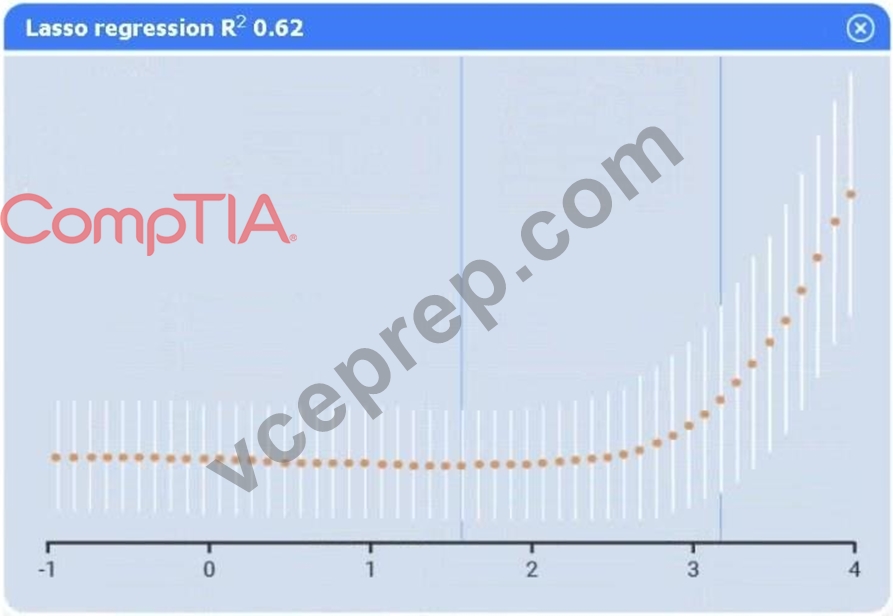
Use the information provided in the table to select the appropriate regression model.
Part 2
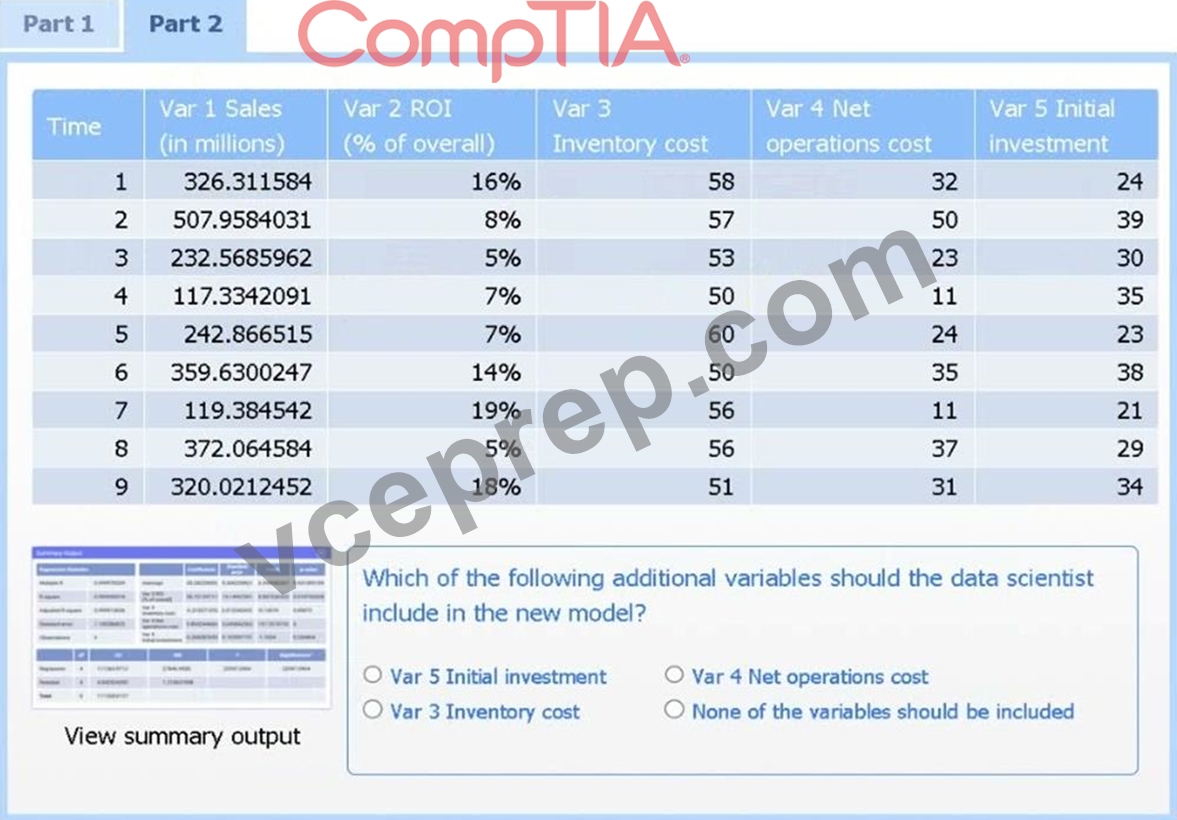
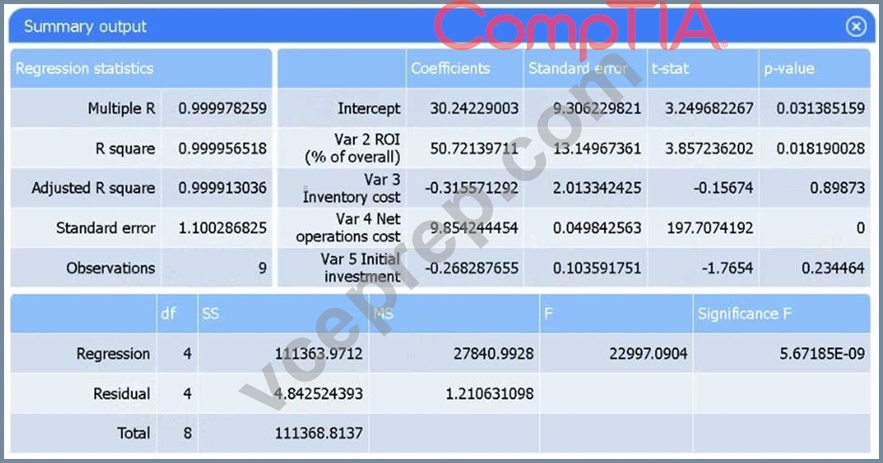
Review the summary output and variable table to determine which variable is statistically significant.
If at any time you would like to bring back the initial state of the simulation, please click the Reset All button.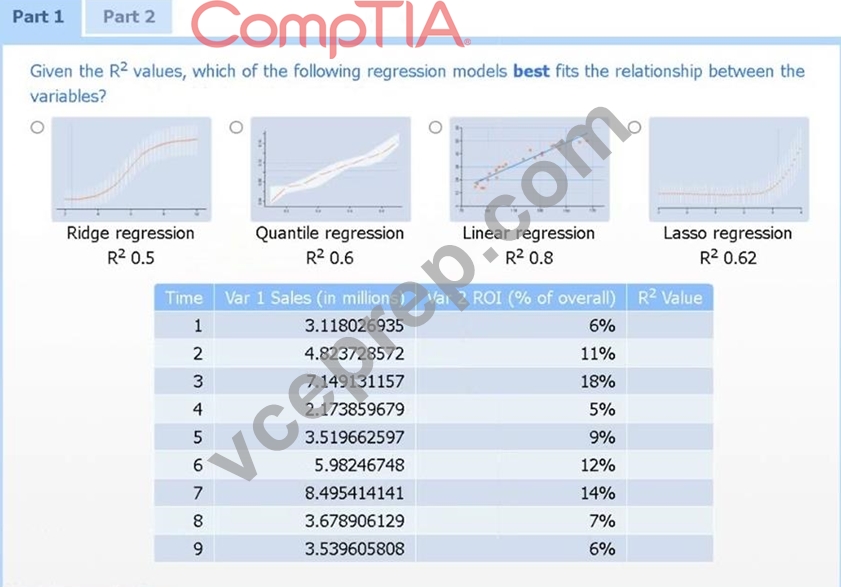
Answer:
Explanation:
Part 1
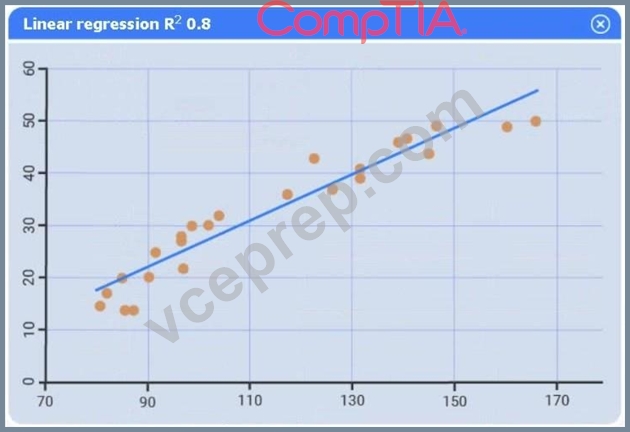
Linear regression.
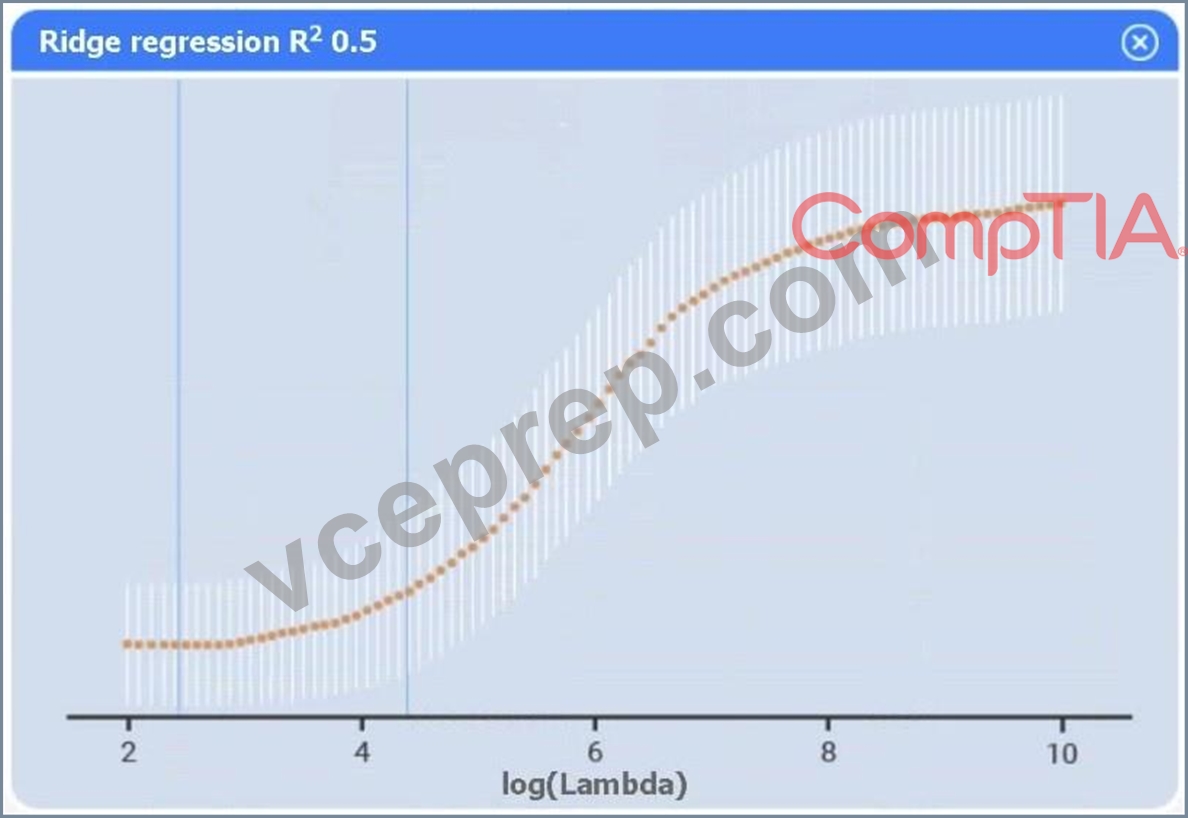
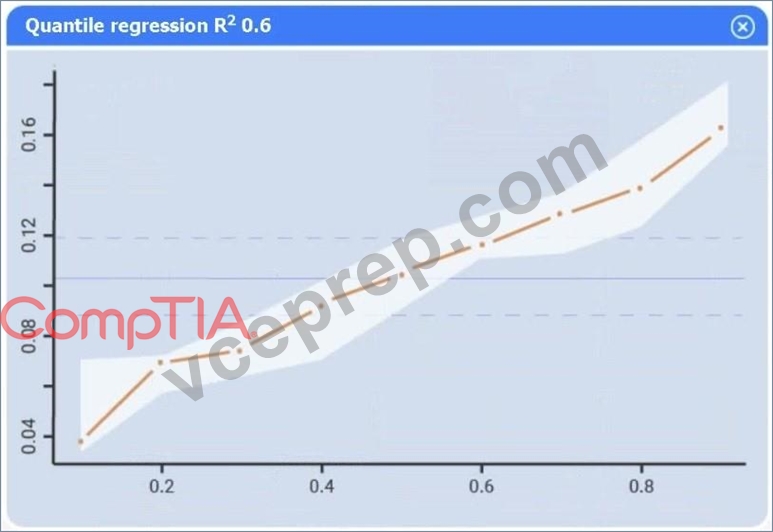
Of the four models, linear regression has the highest R² (0.8), indicating it explains the greatest proportion of variance in sales.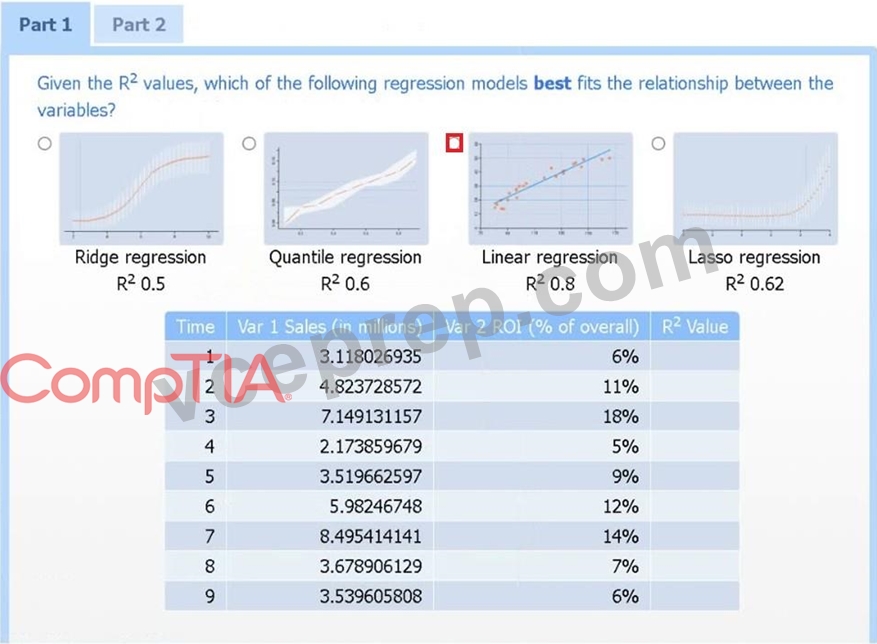
Part 2
Var 4 - Net operations cost.
Net operations cost has a p-value of essentially 0 (far below 0.05), indicating it is the only additional predictor statistically significant in explaining sales. Neither inventory cost (p≈0.90) nor initial investment (p≈0.23) reach significance.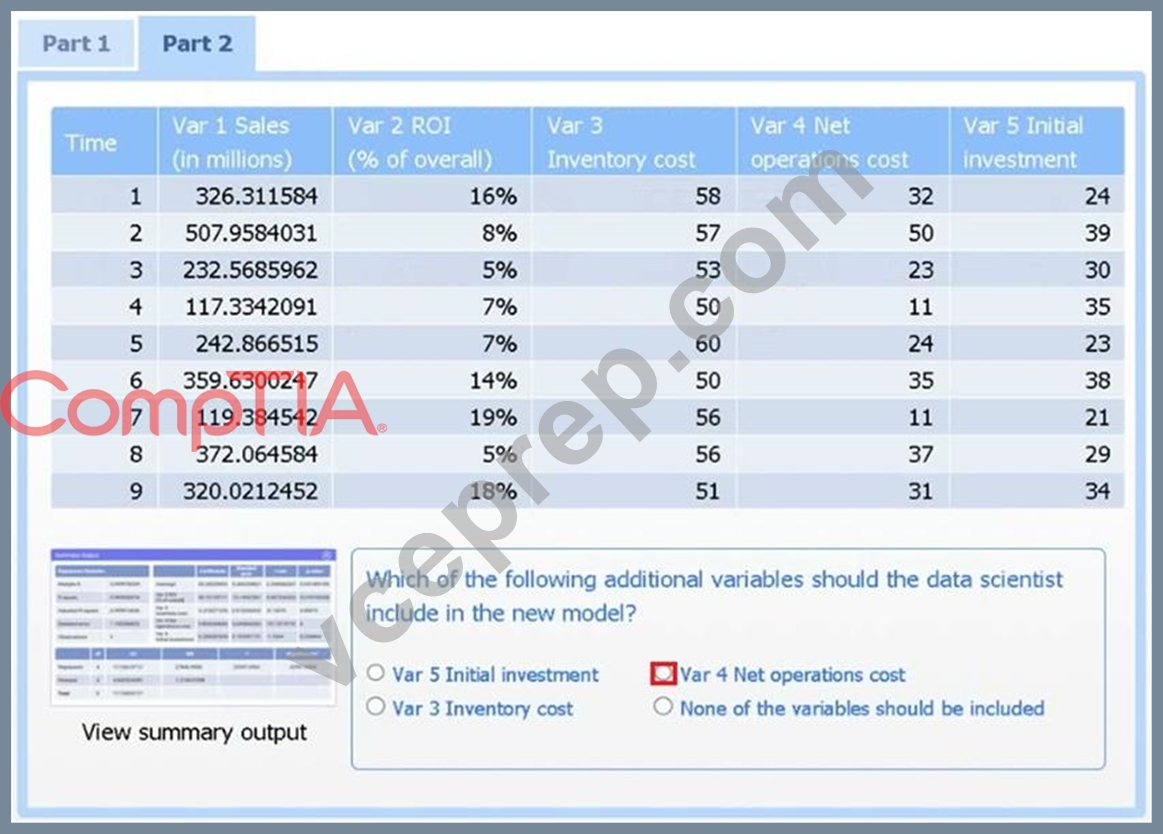
NEW QUESTION # 35
A data scientist has constructed a model that meets the minimum performance requirements specified in the proposal for a prediction project. The data scientist thinks the model's accuracy should be improved, but the proposed deadline is approaching. Which of the following actions should the data scientist take first?
- A. Continue collecting data.
- B. Request additional funding.
- C. Test additional model specifications.
- D. Consult the key project stakeholder.
Answer: D
Explanation:
# The model already meets the performance goals outlined in the project proposal. However, since the deadline is near and the data scientist is considering further improvements, the correct approach is to:
# Consult the key project stakeholder. This ensures transparency and aligns actions with stakeholder priorities
- whether to proceed with deployment or invest in further model tuning.
Why the other options are incorrect:
* A: Collecting more data requires time and may exceed project scope.
* B: Requesting funding is premature and not justified if performance goals are already met.
* D: Testing new models takes time and may delay delivery - stakeholder input is needed first.
Official References:
* CompTIA DataX (DY0-001) Study Guide - Section 5.1:"Stakeholder engagement is critical in project decision-making, especially when trade-offs exist between quality and timelines."
* CRISP-DM Framework - Evaluation Phase:"Before modifying models that meet objectives, it is essential to consult business stakeholders to align with their expectations."
-
NEW QUESTION # 36
Which of the following is a classic example of a constrained optimization problem?
- A. The cold start problem
- B. The traveling salesman
- C. Calculating gradient descent
- D. Calculating local maximum
Answer: B
Explanation:
The traveling-salesman problem seeks the shortest possible route that visits each city exactly once and returns to the start, making it a textbook example of optimization under explicit constraints.
NEW QUESTION # 37
A data scientist needs to analyze a company's chemical businesses and is using the master database of the conglomerate company. Nothing in the data differentiates the data observations for the different businesses. Which of the following is the most efficient way to identify the chemical businesses' observations?
- A. Consult with the business team to identify which sites are responsible for chemical operations and ingest only the relevant data for analysis.
- B. Ingest the data from all of the hard drives and perform exploratory data analysis to identify which business is responsible for chemical operations.
- C. Perform analysis on all of the data and create a summary report on the results relevant to chemical operations.
- D. Ingest data from the hard drive containing the most data and present sample results on the chemical operations.
Answer: A
Explanation:
Engaging the business team leverages domain expertise to pinpoint which records pertain to chemical operations, allowing you to extract and analyze just the relevant subset. This avoids the time and resource waste of ingesting and sifting through unrelated data.
NEW QUESTION # 38
A data analyst wants to generate the most data using tables from a database. Which of the following is the best way to accomplish this objective?
- A. INNER JOIN
- B. LEFT OUTER JOIN
- C. FULL OUTER JOIN
- D. RIGHT OUTER JOIN
Answer: C
Explanation:
A full outer join returns every row from both tables, matched where possible and unmatched rows filled with NULLs, yielding at least as many (and typically more) rows than any other join type.
NEW QUESTION # 39
A team is building a spam detection system. The team wants a probability-based identification method without complex, in-depth training from the historical data set. Which of the following methods would best serve this purpose?
- A. Random forest
- B. Naive Baves
- C. Linear regression
- D. Logistic regression
Answer: B
Explanation:
Naive Bayes directly computes class probabilities using simple frequency counts under the independence assumption, requiring minimal training complexity and no iterative optimization-ideal for fast, probability‐based spam detection.
NEW QUESTION # 40
Which of the following environmental changes is most likely to resolve a memory constraint error when running a complex model using distributed computing?
- A. Migrating to a cloud deployment
- B. Adding nodes to a cluster deployment
- C. Converting an on-premises deployment to a containerized deployment
- D. Moving model processing to an edge deployment
Answer: B
Explanation:
When running a model on a distributed system, encountering memory constraint errors indicates that the current nodes in the cluster do not have enough memory to handle the model. The most scalable and immediate solution is:
# Adding Nodes to a Cluster Deployment - This increases the total available memory and compute power. In distributed computing environments like Apache Spark or Hadoop, horizontal scaling via node addition is a standard remedy for resource bottlenecks, including memory limitations.
Why the other options are incorrect:
* A. Containerizing doesn't inherently solve memory issues unless paired with resource upgrades.
* B. Cloud migration may offer more resources, but without scaling configuration, memory limits may persist.
* C. Edge deployment is for low-latency, local processing - often with less memory, not more.
Official References:
* CompTIA DataX (DY0-001) Official Study Guide - Section 5.2 (Infrastructure & Scaling):"To resolve memory limitations in distributed systems, scaling out by adding nodes is the most direct and cost- effective method."
* Data Engineering Fundamentals (Cloud/Distributed Systems):"Cluster resource constraints (e.g., memory) can be mitigated by increasing node count, enabling parallel execution and expanded memory pools."
-
NEW QUESTION # 41
A data scientist has built an image recognition model that distinguishes cars from trucks. The data scientist now wants to measure the rate at which the model correctly identifies a car as a car versus when it misidentifies a truck as a car. Which of the following would best convey this information?
- A. Confusion matrix
- B. Correlation plot
- C. Box plot
- D. AUC/ROC curve
Answer: A
Explanation:
# A confusion matrix gives a detailed view of a classification model's performance, including true positives, false positives, true negatives, and false negatives. It's the best tool for examining model accuracy and misclassification between specific classes - like mislabeling trucks as cars.
Why the other options are incorrect:
* B: AUC/ROC gives a broader performance summary but not individual class misclassifications.
* C: Box plots show distributions, not classification accuracy.
* D: Correlation plots show relationships between variables - not confusion results.
Official References:
* CompTIA DataX (DY0-001) Study Guide - Section 4.3:"Confusion matrices enable detailed analysis of classification performance and misclassification rates."
* Machine Learning Textbook, Chapter 5:"For evaluating how models classify specific classes, confusion matrices are the most direct and interpretable tool."
-
NEW QUESTION # 42
Which of the following modeling tools is appropriate for solving a scheduling problem?
- A. Decision tree
- B. Gradient descent
- C. Constrained optimization
- D. One-armed bandit
Answer: C
Explanation:
Scheduling problems require finding the best allocation of resources subject to constraints (e.g., time slots, resource availability), which is precisely what constrained optimization algorithms are designed to handle.
NEW QUESTION # 43
Which of the following compute delivery models allows packaging of only critical dependencies while developing a reusable asset?
- A. Containers
- B. Edge devices
- C. Virtual machines
- D. Thin clients
Answer: A
Explanation:
# Containers (e.g., Docker) allow developers to package an application along with only the necessary runtime, libraries, and critical dependencies. This makes the asset lightweight, reusable, and portable across environments. Unlike virtual machines, containers share the host OS kernel and are far more efficient in packaging only what's essential.
Why the other options are incorrect:
* A: Thin clients refer to client-server models with minimal local processing - not relevant to dependency packaging.
* C: Virtual machines include an entire OS, leading to more overhead than necessary for reusable assets.
* D: Edge devices are hardware-based deployments typically used in IoT scenarios, not packaging tools.
Official References:
* CompTIA DataX (DY0-001) Official Study Guide - Section 5.2:"Containers enable consistent development environments by packaging applications and only critical dependencies, making them ideal for portability and reuse."
* Docker Documentation:"Containers package code and dependencies into a single unit of software, ensuring consistency across environments while minimizing overhead."
-
NEW QUESTION # 44
A data scientist is using the following confusion matrix to assess model performance:
The model is predicting whether a delivery truck will be able to make 200 scheduled delivery stops. Every time the model is correct, the company saves an hour in planning and scheduling of maintenance work. Every time the model is wrong, the company loses four hours of delivery time for the truck. Which of the following is the net model impact for the company?
- A. 165 hours saved
- B. 165 hours lost
- C. 25 hours lost
- D. 25 hours saved
Answer: C
Explanation:
Treat each "predicted-to-fail" and "predicted-to-succeed" row as coming from 100 cases apiece (200 total).
NEW QUESTION # 45
A company created a very popular collectible card set. Collectors attempt to collect the entire set, but the availability of each card varies, with because some cards have higher production volumes than others. The set contains a total of 12 cards. The attributes of the cards are below:
A data scientist is provided a historical record of cards purchased, which was acquired by a local collectors' association. The data scientist needs to design an initial model iteration to predict whether or not the animal on the card lives in the sea or on land given the provided attributes. Which of the following is the best way to accomplish this task?
- A. Linear regression
- B. Association rules
- C. ARIMA
- D. Decision trees
Answer: D
Explanation:
You have categorical inputs (wrapper color, shape, animal) and a binary target (sea vs. land). A decision tree natively handles categorical features and yields clear, rule-based splits that predict habitat, making it the most appropriate choice.
NEW QUESTION # 46
Which of the following measures would a data scientist most likely use to calculate the similarity of two text strings?
- A. k-nearest neighbors
- B. Edit distance
- C. Word cloud
- D. String indexing
Answer: B
Explanation:
Edit distance quantifies how many single-character insertions, deletions, or substitutions are needed to transform one string into another, making it a direct measure of their similarity.
NEW QUESTION # 47
......
Powerful DY0-001 PDF Dumps for DY0-001 Questions: https://actualtests.vceprep.com/DY0-001-latest-vce-prep.html